To view as a pdf, please click on the link, http://ucanquit2.org/News/EmailUpdates/Archived.aspx.
 | ||
 | ||
|
New Interactive Quit Planning Tool – Ready2Quit Ready2Quit – our new interactive quit plan tool – is available on UCanQuit2.org! Features of Ready2Quit:
Ready2Quit can be accessed on any desktop, tablet or mobile device at UCanQuit2.org/Ready2Quit
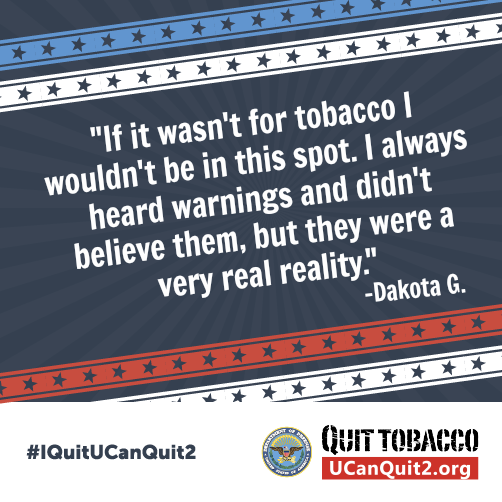
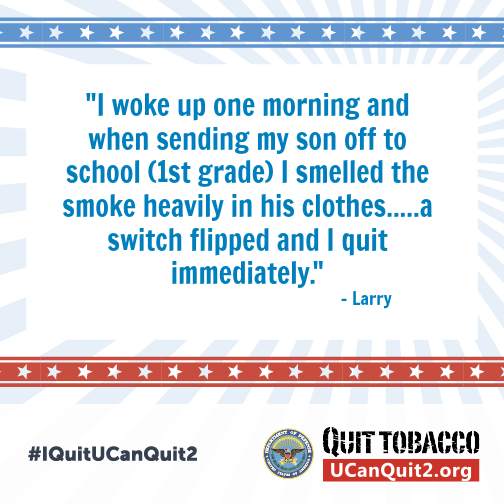
I Quit, You Can Quit Too: Quit Stories There is no better advocate for quitting tobacco than a former smoker or dipper. Your quit story can help make a difference to someone who is trying to quit or just needs that extra support and motivation. #IQuitUCanQuit2
Check out the new quit stories on Quit Tobacco's Tumblr page. | ||
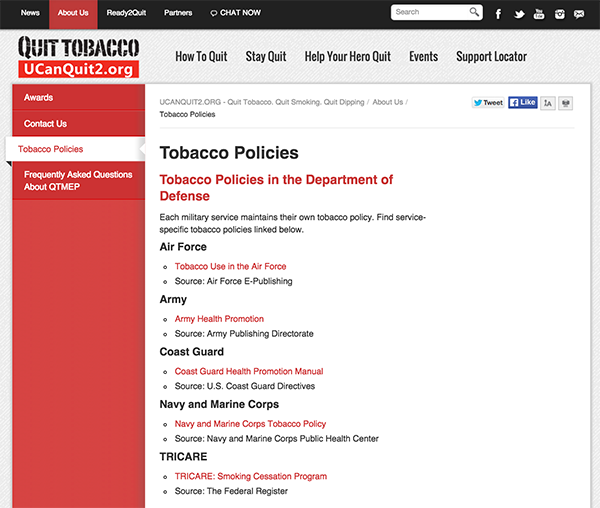
Check out the new tobacco policies section on UCanQuit2.org. | ||
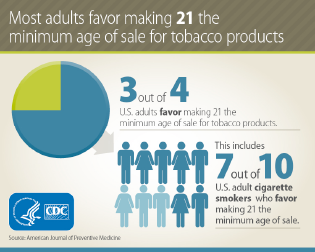
Adults Favor Raising Minimum Age For Tobacco Products Sales To 21
Three out of 4 American adults—including 7 in 10 cigarette smokers—favor raising the minimum age of sale for all tobacco products to 21, according to an article by CDC published in the American Journal of Preventive Medicine. While an overwhelming majority of adults favored the policy overall, favorability is slightly higher among adults who never smoked and older adults. In contrast, 11 percent of adults strongly opposed making 21 the legal age of sale, while 14 percent somewhat opposed such measures. In most states, the minimum age of sale for tobacco is 18; in Alabama, Alaska, New Jersey and Utah the minimum age of sale is 19. One state—Hawaii—currently prohibits sales of tobacco products to youth under the age of 21. Additionally, several cities and counties across the U.S. have adopted laws raising the minimum age to 21, starting with Needham, Massachusetts, in 2005. New York City; Hawaii County, Hawaii; Evanston, Illinois; Englewood, New Jersey; Columbia, Missouri; and several other communities in Massachusetts later followed suit. Click here to view the press release from CDC.
Can Social Media Help You Quit Smoking? A recently published quasi-experimental study tried to determine the effectiveness of social media as a quitting tool by studying the Canadian “Break It Off” (BIO) campaign aimed at smokers aged between 19 and 29. The researchers compared BIO to a telephone smokers' helpline service. The BIO website featured details of traditional cessation methods (telephone counseling and NRT) but also encouraged users to upload a YouTube video of their quitting experience and announce their resolve to friends via Facebook. There was also a BIO smartphone app that offered instant advice messages and personal progress-tracking to help deal with cravings. Click here to view the article from The Conversation.
25 To 36? 5 Reasons To Quit Smoking Nearly 27 percent of Delawareans between 25 and 36 reported in 2013 that they characterized themselves as smokers, a number state officials call startling. That rate is the highest among Delaware adults and youth. Click here to view the article from the Delaware News Journal.
'Chicago' Drummer On Anti-Tobacco Crusade After Cancer Scare The drummer for the legendary band Chicago, Tris Imboden, is now a leading anti-tobacco activist. His passion comes from his own experience as a cancer survivor. Imboden is the heartbeat of the band Chicago, but thanks to a bout with lung cancer seven years ago, Imboden performs without most of one lung. "Gratefully, I've been blessed with an enormous lung capacity considering I'm now minus two-thirds of my right lung," Imboden said. Like so many rock and roll musicians, partying and smoking cigarettes was just part of the lifestyle. But now that he is a rare lung cancer survivor, his band has gone tobacco free and Imboden has become a volunteer spokesman for the American Cancer Society's Cancer Action Network. Click here to view the article from ABC 7.
Low-Nicotine Cigarettes Won't Necessarily Help Smokers Stop Low-nicotine cigarettes alone don't help smokers quit over the long term, a new study finds. "We don't know that very low-nicotine cigarettes will not reduce nicotine dependence, but progressively reducing nicotine content of cigarettes in the way that we did, without other means of supporting smokers, did not produce the desired results," study leader Dr. Neal Benowitz, a professor in the departments of medicine and bioengineering and therapeutic sciences at the University of California, San Francisco, said in a university news release. Click here to view the article from Healthday News.
Lung Cancer Patients Who Quit Smoking Live Longer Lung cancer patients live longer if they quit smoking around the time of their cancer diagnosis, a new study finds. Researchers looked at 250 lung cancer patients who were smokers and were referred to a program to help them stop smoking. Fifty had recently quit smoking, and 71 had quit smoking soon after being referred to the tobacco cessation program. Those who quit smoking shortly before or after they learned they had lung cancer lived an average of 28 months. Those who continued to smoke lived an average of 18 months, the study found. Even patients with advanced lung cancer gained extra survival time if they quit smoking, the study in the July issue of the Journal of Thoracic Oncology showed. Click here to view the article from Healthday News. | ||
E-Cigarettes May Be Just As Addictive As The Real Thing While electronic cigarettes, commonly known as "e-cigs," have a reputation as a tool to help smokers quit, new research suggests they may be just as addictive as traditional cigarettes. E-cigarettes do not burn tobacco, but they do heat and vaporize liquids that contain nicotine, flavorings and other substances. Previous studies had yet to investigate which of the three types of nicotine - each at various levels of addictiveness - were used in these liquids, and therefore, how likely a user was to get hooked. Researcher Najat Saliba of the American University of Beirut and his team set out to answer this question by testing commercial samples of the liquids made for e-cigarettes. The results of the study, published in the American Chemical Society's journal Chemical Research in Toxicology, found that "free-base" nicotine - believed to be the only kind that gets absorbed by the body, making it the most addictive - was the most commonly used. Click here to view the article from CBS News.
The Cool Factor: Teens Report Positive Feedback To Using E-Cigarettes An estimated 40 percent of teen users of e-cigarettes have never smoked tobacco, a new report finds, adding to the worries that the devices are attracting a whole new group of underage user, not just teens trying to quit regular cigarettes. Even more alarming, 91 percent of teens who use e-cigarettes report getting positive feedback about them. The study, published in Pediatrics, highlights the challenges facing public health officials trying to prevent teens from using any form of nicotine. The fear is, after years of declining adolescent tobacco smoking rates, increasing use of e-cigarettes among teens could lead to a "renormalization" of smoking behavior among teens. Click here to view the article from Today.com. Click here to view the abstract from Pediatrics.
E-Cigarette Industry Has Few Rules, But Change Seems Likely The Vapor Spot doesn’t immediately conjure images of the Wild West. There’s a curved, neon-backed bar and full-length windows at the downtown Sacramento shop. The high exposed ceilings are decked with orbed light fixtures to give the expansive space a warm glow. It may appear laid back. But there is real muscle beneath the specialty e-cigarette retailer’s trendy skin: a booming billion-dollar industry that has operated largely free of government regulations, ruled almost entirely by small business vigilantes who are making hefty profits. If it’s not a Wild West, it’s close. But with anti-smoking groups demanding change, government regulations are all but imminent. One California state lawmaker backs legislation that would regulate e-cigarettes as tobacco. In 2014, there were roughly 25,000 e-cigarette retailers in the U.S., the Stanford Prevention Research Center estimated. But with 1,400 vape shops in California alone, proponents consider it the epicenter of the movement. Click here to view the article from the Washington Times. | ||
Be in the POC Spotlight Share your cessation activities! We would like to hear about how you are promoting tobacco cessation and using our materials on your installation. Email us at info@UCanQuit2.org.
Join Us on Facebook and Twitter Find us on Facebook and Twitter to check out our daily posts. Your participation helps to create an online community to support and encourage those you are helping to quit tobacco. Look for our periodic Facebook events.
Put Facebook to Work “Like” Quit Tobacco - UCanQuit2.org and then use our page as a forum to converse with other military health professionals. “Share” selected Quit Tobacco Facebook posts on your installation Facebook page to encourage service members to check out Quit Tobacco on Facebook. But don’t stop there—reach out to your command and/or Public Affairs Officer and ask them to like our page—all it takes is a click.
For more information on this campaign, please contact info@UCanQuit2.org. | ||





 | Learn more about Quit Tobacco at UCanQuit2.org. |
| STAY CONNECTED: | |||||||||
| |||||||||


| SUBSCRIBER SERVICES: | ||||||
| Manage Preferences | | | Delete profile | | | |||

ReplyDeleteWe know that health is wealth but extra health is not good for every person. I am very happy to your fantastic service about Quit smoking service , so awesome all tips about Quit smoking service . Present every person are aware about extra health and also know how to effaced our body.Some days ago I have gotten and this related site and here has many only support. If you need also more information please see below link.
Virginia hypnosis Bruxism